

Why Book Activities Before Travel? Save Time and Money
- September 16, 2026
- Activities
Book activities before travel to secure popular times, compare trusted options, protect your budget, and arrive ready for every great day ahead... Read More
 by mysoov_admin
A child who is tall for their age may still not be ready to parasail. A smaller adult may be perfectly eligible one day and need to wait the next because the wind has changed. That is why parasailing age weight limits are not a single universal rule – they are a safety decision made by the local operator, using the day’s weather and the equipment in use.
For families, couples, and groups planning a beach vacation, this is good news as long as you check the details before you book. Parasailing can be a calm, memorable way to see a coastline from above, but it works best when every flyer meets the operator’s requirements and feels comfortable with the experience.
Most parasailing operators set both a minimum age and a minimum combined flight weight. They may also apply a maximum weight limit for each flight. The exact numbers can differ between destinations, boats, parachute systems, and weather conditions, so a rule you saw for one beach should not be treated as the rule everywhere.
Age rules are usually designed around a child’s ability to understand instructions, sit securely in the harness, and stay calm during takeoff and landing. Many operators allow children from around ages 5 to 8, but some require participants to be older. A parent or legal guardian may need to sign a waiver, and younger flyers are often paired with an adult rather than flying alone.
Weight is even more variable. Parasailing boats commonly fly one, two, or three guests at a time, depending on the equipment and conditions. The operator uses combined passenger weight to determine whether the parasail will lift correctly and land safely. On a calm day, a lighter pair may be able to fly together. In stronger wind, the crew may need a heavier combined load, a different pairing, or may decide not to fly at all.
Think of published limits as a starting point, not a promise. In many popular beach destinations, operators use a minimum individual or combined weight somewhere around 100 to 150 pounds. Maximum combined flight weights are often in the 400 to 500 pound range, though this can be lower or higher based on the boat, parasail, and conditions.
A common question is whether a child can fly with two adults. Sometimes, yes. But the crew will not simply add up weights and approve the flight. They also consider how passengers will fit into the harness setup, whether the total is appropriate for the wind, and whether all participants can follow instructions. Safety calls made at the dock are part of a professionally run parasailing operation.
Individual upper weight limits can matter too. Some harness systems and boats have restrictions that make certain arrangements unsuitable, even when the group’s combined weight appears to fit the posted range. Be honest when providing passenger weights. It is not about judgment – it is how the crew plans a safe flight configuration.
Wind direction, wind speed, sea conditions, rain, and visibility can all affect parasailing. A limit listed online may be adjusted on the day of your activity. This is especially common when conditions are marginal, when a light child needs to fly with an adult, or when a group of three is close to the operator’s maximum combined weight.
That flexibility is a positive sign, not an inconvenience. A trusted local partner should be willing to delay, reschedule, change pairings, or cancel when conditions do not support a safe flight. Avoid operators that promise they can fly anyone, anytime, regardless of the weather.
If you are booking parasailing for a child or teenager, ask about the minimum age, minimum weight, and whether the child must fly with an adult. Also confirm whether the age requirement changes for solo, tandem, or triple flights. A teenager who meets the minimum age may still be asked to fly with another participant if they are below the preferred weight range for a solo flight.
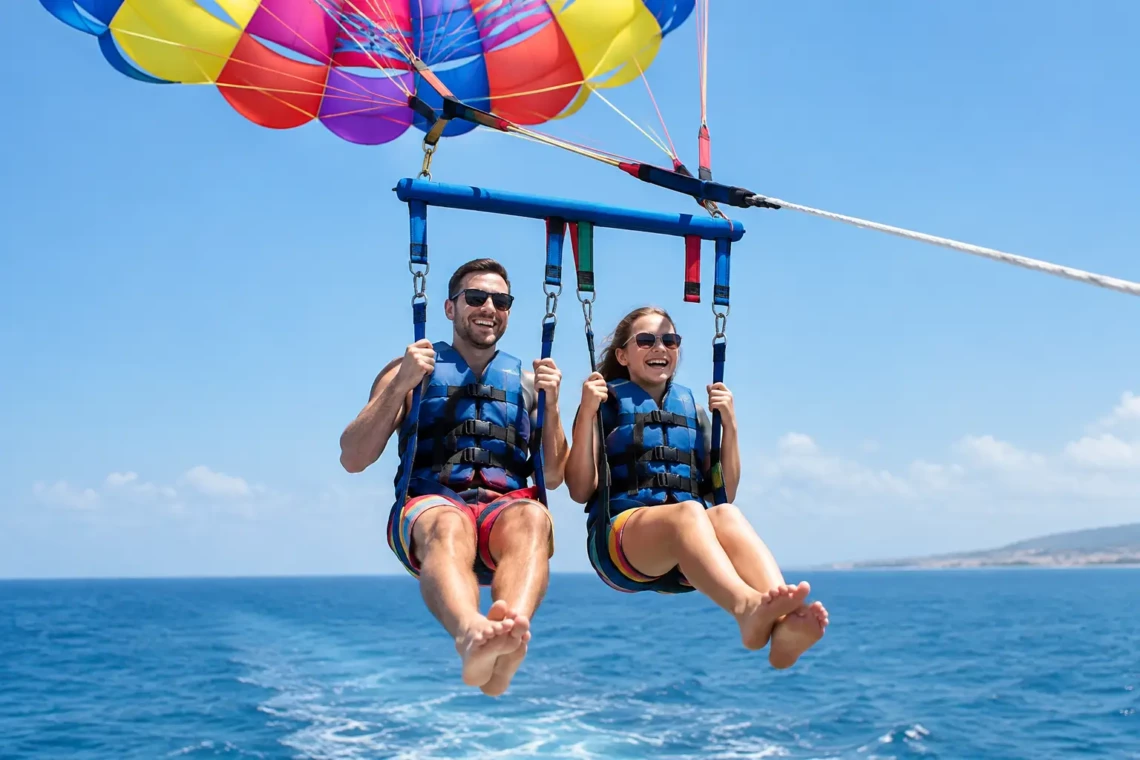
It also helps to explain the activity clearly before you go. Parasailing generally involves a gradual lift from the back of a boat while seated in a harness, followed by a controlled return to the boat. There is no need to jump from the vessel. Still, children should be comfortable on a boat, able to wear a life jacket properly, and willing to listen closely to the crew.
Children who are anxious about heights, motion sickness, or open water may prefer a different beach activity. There is no prize for pushing through an experience that does not feel right. A jet ski circuit, boat cruise, or beach day can be a better fit, depending on the traveler.
Groups often assume everyone can take part together, but parasailing is scheduled in small flight groups rather than as one large group. Your party may go out on the same boat but fly in pairs or trios selected by the crew. This is where accurate weight and age information makes the day smoother.
When booking, share the number of participants, approximate ages of minors, and accurate weights if requested. Mention anyone with limited mobility, recent surgery, pregnancy, a heart condition, or another medical concern. Parasailing may not be suitable in those situations, and the operator’s rules should always come first.
For birthdays, bachelor or bachelorette trips, and family reunions, leave room in your itinerary. Boat departure times can shift with weather and demand. Booking the activity early in your vacation gives you more flexibility if the operator needs to move you to another time or day.
If a participant does not meet the age or weight requirement, the crew may offer a different flight pairing if one is safe and available. If that is not possible, that person may be able to join the boat as an observer, depending on capacity and the operator’s policy. Do not count on this option without checking in advance.
The best way to avoid disappointment is to review the activity details before payment and ask questions before travel, particularly if a child is close to the minimum age or weight. At Mysoov, we believe a hassle-free activity booking starts with clear expectations, tested partners, and support when plans need adjusting.
Possibly, but it depends on the destination and operator. Some providers accept children around this age if they meet the minimum weight and fly with an adult. Others have a higher minimum age. Confirm both requirements before booking.
Usually there is a maximum individual or combined passenger weight, but it is not always fixed. The crew may lower the allowed total when wind or sea conditions require it. Their decision on the day is final.
They may be able to, but only if their combined weight meets the operator’s minimum for the conditions. If not, the crew might pair each person with another passenger or ask them to wait for different conditions.
Most operators focus more on health, mobility, and the ability to follow safety instructions than on a maximum age. An active older adult may be welcome, while someone with a relevant medical condition may be advised not to participate. Check directly if there is any doubt.
A parasailing photo looks effortless, but the best trips are planned with the practical details in mind. Check the limits early, choose a reputable operator, and let the crew make the weather call. Then you can spend less time negotiating at the dock and more time enjoying the view.

Book activities before travel to secure popular times, compare trusted options, protect your budget, and arrive ready for every great day ahead... Read More
Plan jet ski tours with clear pricing, tested local operators, and practical tips on routes, safety, timing, and what to bring for... Read More

Plan buggy tours with confidence: compare routes, safety, timing, and group options to book an off-road experience that delivers real vacation value. Read More